Kunio Maekawa
| Kunio Maekawa | |
|---|---|
 Maekawa House in the Edo-Tokyo Open Air Architectural Museum |
|
| Born | 14 May 1905 Niigata, Niigata |
| Died | 26 June 1986 |
| Nationality | Japan |
| Work | |
| Buildings | The National Museum of Modern Art, Tokyo |
Kunio Maekawa (前川 國男 Maekawa Kunio, 14 May 1905-26 June 1986) was a Japanese architect.
Contents |
[edit] Formative years
He entered First Tokyo Middle School in 1918, and then Tokyo Imperial University in 1925.[1] After graduation in 1928, he travelled to France to apprentice with Le Corbusier. In 1930 he returned to Japan and worked with Antonin Raymond, and in 1935 established his own office. His own house has been described as his starting point, in which he brought the idea of piloti inside the house, to create a two-storey space. The original house has been dismantled and relocated to the Edo-Tokyo Open Air Architectural Museum.[2]
[edit] Selected projects
- 1932 Kimura Industrial Laboratory, Hirosaki, Aomori
- 1942 Maekawa House
- 1952 Nippon Sogo Bank, Tokyo
- 1954 Kanagawa Prefectural Library and Music Hall, Yokohama, Kanagawa
- 1955 The International House of Japan, Tokyo (with Junzo Sakakura and Junzo Yoshimura)
- 1956 Fukushima Education Center, Fukushima
- 1960 Kyoto Kaikan, Kyoto
- 1961 Tokyo Bunka Kaikan, Ueno, Tokyo
-

Kanagawa Prefectural Library and Music Hall, Yokohama (1954)
-

The International House of Japan, Tokyo (1955)
-

Fukushima Education Center, Fukushima (1956)
-
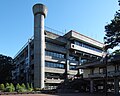
Setagaya Ward Office
-

Tokio Marine & Nichido Fire Insurance Head Office (1974)


[edit] References
[edit] Notes
- ^ Reynolds 2001, pp. 38–44
- ^ Fujimori 2008
[edit] Sources
- Reynolds, Jonathan M. (2001), Maekawa Kunio and the Emergence of Japanese Modernist Architecture, University of California Press, ISBN 0520214951
- Fujimori, Terunobu (2008), "Modernism and the Roots of Contemporary Architecture", Kateigaho International Edition 20 (3), http://int.kateigaho.com/list_26.html, retrieved 2010-03-29
[edit] External links
 |
Wikimedia Commons has media related to: Kunio Maekawa |
- Mayekawa Associates
- Daniell, Thomas On Kunio Maekawa
  |
This article about a Japanese architect is a stub. You can help Wikipedia by expanding it. |

